On-line exhibition

Left-handed Torah pointers

The Torah, which contains the Five Books of Moses, is the central concept of the Jewish religion. In its physical form, it is a parchment scroll which, when not in use, is kept in an ornamental cabinet at the front of the synagogue. Out of reverence, the Torah scroll is covered with a decorative mantle of cloth, over which are placed a set of adornments – finials or a crown (over the upper ends of the rollers), a shield, and a hand-shaped pointer (hung in front of the scroll when stored in the ark). Although the pointer is one of the Torah ornaments, its main function is practical; it is used to follow the text as it is being read so as to avoid any mistakes. In addition, the pointer ensures that the scroll is not touched with one’s hands – which is prohibited – when reading from it.

The physical form of the Torah pointer is reflective of its purpose and its use, which is far more intensive than that of other types of Torah ornaments. It is fairly compact, usually with few decorative elements, and of a size that allows for comfortable and safe use. The typical pointer made in Central Europe has a shaft which terminates in a small hand with an extended index finger, drawing attention to its use. The pointer’s segments (handle and reading end) are articulated by knops roughly halfway along the length of the shaft. A chain is attached to the rear end of the shaft to suspend the pointer from the Torah staves. In the collection of the Jewish Museum in Prague, however, there is also a small group of Torah pointers that differ in one small detail from all the others – the reading end is shaped as a left hand.

About one-tenth of the human population are left-handed. Like any difference, left-handedness was once regarded as suspicious and inappropriate, and the bearers of this trait were restricted in many ways. Indeed, until historically very recent times, various efforts were often made to ‘re-educate’ left-handed people. In Judaism, left-handedness was originally defined as a physical defect. This definition was of grave significance to left-handed people; it provided a basis to prevent them from being called upon to read from the Torah, which in effect led to a substantial decline in their social status and to their marginalization from the Jewish community. From about the end of the 18th century onwards, however, this attitude was gradually relaxed, and left-handed people over time became full members of the Jewish community. Left-handed Torah pointers are a visible expression of the emancipation of these people, reminding us that left-handedness is no longer a reason to discriminate.

This exhibition was put together by Jaroslav Kuntoš.

Translantion: Stephen Hattersley

  • Torah pointer, 1769 - 1776

    Brno, 1769-1776, Jan Christian Fischer

    Silver, cast, hammered and cut

    This is the oldest left-handed Torah pointer in the collection of the Jewish Museum in Prague. It is worth mentioning the rather large size of the hand, which was probably made to order. It remains unclear whether it is the original hand or a later version.

    Inv.No. JMP 012.176

  • Torah pointer, 1785 - 1799

    Central Europe, late 18th century, unmarked by maker

    Silver, cast and hammered

    The dedicatory inscription states that the pointer was donated by the esteemed KHRR Abraham KC on behalf of his son Issachar Beer. If the inscription dates from the same time as the pointer, this would mean that Issachar Beer was probably left-handed.

    Inv.No. JMP 010.709

  • Torah pointer, 1807

    Central Europe, 1807, unmarked by maker

    Wood, carved

    Inv.No. JMP 101.999/02

  • Torah pointer, 1810 - 1812

    Linz, 1810-1812, maker unknown

    Silver, cast and hammered

    This pointer has a fairly small hand. Only a fragment of the dedicatory inscription has been preserved, and the donor’s name can no longer be identified.

    Inv.No. JMP 017.019

  • Torah pointer, 1800 - 1850

    Central Europe, first half of 19th century, unmarked by maker

    Wood, carved

    Although the hand is badly damaged, it is evident that it was originally left-handed.

    Inv.No. JMP 061.665

  • Torah pointer, 1800 - 1850

    Central Europe, first half of 19th century., unmarked by maker

    Wood, carved and silver-coated

    Apparently, the donor of this pointer could not afford a silver pointer, so he chose the option of coating the wooden base with silver leaf.

    Inv.No. JMP 059.315

  • Torah pointer, 1830 - 1860

    Vídeň, ca 1830-1860, maker AW

    Silver, cast, hammered and chased

    Inv.No. JMP 012.244

  • Torah pointer, 1840 - 1860

    Central Europe, kolem poloviny 19. stol., unmarked by maker

    Wood, pewter, lathe-spinned and cast

    This pointer is comprised of somewhat disparate parts. The rough workmanship of the hand suggests that it was made by an amateur.

    Inv.No. JMP 007.515

  • Torah pointer, 1840 - 1860

    Central Europe, half of 19th century, unmarked by maker

    Wood, carved and lathe-spinned

    Inv.No. JMP 061.664

  • Torah pointer, 1840 - 1860

    Central Europe, half of 19th century, unmarked by maker

    Wood, carved and lathe-spinned

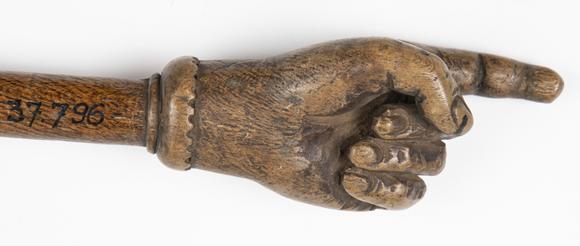
    The hand of this pointer is very large and is rendered very realistically. The attempt to draw attention to the donor’s left-handedness is quite unmistakable here.

    Inv.No. JMP 037.796

  • Torah pointer, 1856

    Vídeň, 1856, maker AW

    Silver, cast, hammered and chased

    According to the the dedicatory inscription, this pointer was donated by women with generous hearts from the Klausen Synagogue, one of whose family members was probably left-handed.

    Inv.No. JMP 017.590

  • Torah pointer, 1857

    Central Europe, 1857, unmarked by maker

    Wood, carved

    According to the the dedicatory inscription, this pointer was donated in 1857 by a man named Judah.

    Inv.No. JMP 104.789

  • Torah pointer, 1850 - 1899

    Central Europe, second half of 19th century, unmarked by maker

    Alpacca, hammered, pressed and silver-coated

    Inv.No. JMP 013.516

  • Torah pointer, 1850 - 1899

    Central Europe, second half of 19th century, unmarked by maker

    Wood, carved and lathe-spinned

    This is another pointer with a slightly oversized hand.

    Inv.No. JMP 004.386

  • Torah pointer, 1850 - 1899

    Central Europe, second half of 19th century, unmarked by maker

    Wood, carved and lathe-spinned

    Inv.No. JMP 174.613

  • Torah pointer, 1850 - 1899

    Central Europe, second half of 19th century, unmarked by maker

    Wood, carved

    Inv.No. JMP 032.395

  • Torah pointer, 1880 - 1899

    Central Europe, late 19th century, unmarked by maker

    Brass, cast, lathe-spinned and silver-coated

    Inv.No. JMP 065.674

  • Torah pointer, 1880 - 1899

    Central Europe, late 19th century, unmarked by maker

    Brass, cast, lathe-spinned and silver-coated

    Inv.No. JMP 098.021

  • Torah pointer, 1901 - 1933

    Central Europe, first third of 20th century, unmarked by maker

    Brass, hammered and silver-coated

    Inv.No. JMP 044.191

All on-line exhibitions