On-line exhibition

The Yahrzeit Is Not a Season

In a small-town shul (synagogue) there’s a dispute about who should daven shacharit (say morning prayers) far’n omed (at the pulpit). One Jew shouts out: “I have a Yahrzeit today, so I have to daven today!” A second Jew shouts out: “Yahrzeit is Yahrzeit. But I, I have shloshim (the thirtieth day of mourning) today. I take precedence, I have to daven! A third Jew shouts out: “It’s not even 14 days since my father died, I have to daven.” And while they are arguing, another Jew goes up to the pulpit and shouts out: "I myself am a corpse, so I have to daven!”

This charming joke appeared in Židovské zprávy [Jewish News] (Volume 18, No. 38, p. 4) on 20 September 1935, as written by Josef Pollák, later the chief curator at the Central Jewish Museum in Prague. What does Yahrzeit mean? For those who speak German, this word can evoke one of the four seasons. But in Yiddish, the term Yahrzeit (or yortsayt, sometimes spelled jahrzeit) has taken on a different meaning: it refers to the anniversary of the day of death of a loved one. Important members of the community and, in particular, influential scholars are also commemorated on their Yahrzeits by unrelated persons. Their graves are visited by their former pupils, and these Yahrzeits are memorable days for the entire community. Until the 19th century, it was not difficult to determine the date of a Yahrzeit, as it corresponded to the Hebrew date of death, or, less frequently, to the date of the funeral of the person being commemorated. A certain problem could have occurred only in the event of a postponed funeral that took place later than the second day after a death, or if the person died during a leap year in the first or second month of Adar. The religious literature provides solutions for such cases. The time of remembrance for the deceased came to be seen as a more general complication only with the changing perception of time in the Jewish world in connection with the problems brought about by the Jews’ shift towards the civil/Gregorian calendar.

The Yahrzeit date is calculated according to the Jewish calendar, which differs in many ways from the civil calendar. It represents the traditional count of years since the creation of the world as described in Genesis; the year 2021, for example, corresponds to 5781. Based on the lunar calendar, the months are either 29 or 30 days long. As a result, the Jewish year is eleven days shorter than the standard solar year. In order to keep the dates of Jewish holidays aligned with the seasons, a thirteenth month is added to the Jewish calendar in a leap year; this happens seven times in nineteen years.

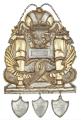
The collections of the Jewish Museum in Prague contain a set of Yahrzeit plaques, which are traditionally used to memorialize the passing of a loved one. Each plaque is inscribed with the Hebrew name of the person who is to be remembered in prayer (including the names of their father and/or mother). The main purpose of the Yahrzeit plaque is to record, for several years in advance the civil calendar dates that correspond to the Hebrew date of death of the departed (usually a parent, or both parents). These dates also impact the family life of the bereaved: on the Yahrzeit of the departed, it is not appropriate to attend any celebrations or parties, to make wedding preparations, or to indulge in entertainment. Yahrzeit plaques recall that the death of a person is part of the lives of others. Despite the solemnity, the Yahrzeit ritual provides a comforting way to remember a loved one for many years to come.

Exhibition created by Lenka Uličná

Translation: Stephen Hattersley

  • Kaddish, 1935

    In their thoughts and prayers, Jews commemorate the deceased throughout the year. In addition to reciting memorial prayers four times a year (on Yom Kippur, Shavuot, Pesach and Shmini Atzeret), the bereaved commemorate their departed loved ones in particular on the anniversary of their death. On this day, mourners recite Kaddish for the departed. This prayer is an integral part of the synagogue service. There are several versions, but only Kaddish Yatom (Orphan’s or Mourner’s Kaddish) and Yahrzeit Kaddish are associated with mourning and remembering the dead. El Male Rachamim (“God full of compassion”) is another synagogue prayer for the departed.

  • Kaddish, 1935

  • Yahrzeit (memorial) candle

    On the day of the Yahrzeit, a male relative of the deceased is usually called up to the Torah. In addition, a candle is lit in the synagogue or at home and will typically burn for 24 hours. It is also customary to visit the grave of the deceased and, according to some traditions, to honour the deceased by studying the Torah or fasting and donating to a charitable cause in their memory.

  • Commemorative sheet, 1871

    Commemorative sheet commemorating a gift by Mr. Leopold Kohn to Hříškov Synagogue and the commitments of the community members on the day of his Yahrzeit

    Gedenktafel le-dorot acharonim.

    Lob denjenigen welchen Lob gebührt!

    Die zum Nutzen der Mit- und Nachwelt wirken. Solch edlen Seelen reihete sich würdig an der gewesene Kultusgemeinte Vorsteher Herr Leopold Kohn indem er der Hrischkower Synagoge ein Legat von 100 Gulden Oest. Währung als unangreifbare Fondation testirte deren Interessen jedoch der Hrischkower Synagoge zufallen. Der jeweilige Kultus-Gemenide-Vorsteher hat darüber zu wachen, dass am Jahrzeitstage des seligen Kohn nämlich an 3. kislev dieewige Lampe auf 24 Stunden angezündet und vom Rabbiner mišnajot und Kaddish Messe gelesen und der mazkir nešamot für dessen Seelenheil gebetet werde.

    Sein Name war:

    Avraham Jehuda ben Jocheved

    Erwähnte Verpflichtungen übernehmen für sich und ihre Nachkomen Der Kultus und Religions Vorstand Hřischkow 631 (1871)

  • Yahrzeit plaque, after 1936

    Yahrzeit plaque of Dr. Ludvik Roubiček, who died in 1936.

    The frame and Czech-language heading are pre-printed, the details are stamped or added in ink, and the name is in gilt letters. The calligrapher was Jindřich Khuher, a Viennese cantor. Czech-language plaques did not appear until the 1930s. The vast majority of Yahrzeit plaques are written in German. The incorrect diacritical marks indicate the difficulties faced by the calligrapher in writing Czech words.

  • Donation certificate, 1901 - 1933

    Diploma and Yahrzeit plaque presented to the Edat Yeshurun association of Moravská Ostrava for its donation to the Kolel Shomre Hachomot charity in Jerusalem. The donation, delivered by Mr. E. Bass, was made in memory of Jehiel Max Beer. Donating to charitable causes is part of the process of commemorating the deceased and of perpetuating their memory.

  • Yahrzeit plaque, after 1924

    Yahrzeit plaque of Mrs. Franziska Siegmann, who died in 1923.

    Calculating the date was made difficult by the fact that Mrs. Siegmann died on the evening of 13 December, which corresponds to the following day on the Jewish calendar (the Jewish day begins at sunset). Another complication is the discrepancy between the start of the new year in the civil calendar and the Jewish calendar, which begins in the autumn. In the event of a death at the turn of the civil year, it may happen that the pre-printed years do not correspond to the Yahrzeits, of which there are sometimes two in a civil year. This is why this plaque contains a number of deletions and corrections.

  • Yahrzeit plaque of the husband and wife Wolf and Sarah Pascheles, after 1886

    On the sides are two celluloid figures depicting Moses and Aaron with their usual attributes. At the top are three Eternal Light lamps. The anniversary dates are pre-printed and handwritten in ink on the two paper charts.

    In addition to the practical side, Yahrzeit plaques also have strong aesthetic purposes. These include the original simple plates that were sometimes printed as part of personal prayer books, as well as geometric frames and the later, richly decorated lithographs with depictions of funereal architecture and mourning figures. Some were also adorned with photographs of the deceased. Their ornamentation corresponds to the concept of hiddur mitzvah (“the beautification or enhancement of a commandment”), which involves the tradition of fulfilling a mitzvah through aesthetic thoughtfulness – in this case, commemorating the dead in a way that pleases the senses.

    Earlier plaques are usually handwritten, later ones usually contain a pre-printed chart with the details stamped or added in ink. Yahrzeit plaques were produced by several publishers and printers. The famous Prague Pascheles' publisher house also made full use of the economic potential of making such plaques. Somewhat paradoxically, the Yahrzeit plaque of Wolf Pascheles and his wife is not printed, but embroidered on a textile background with the details added on paper. His plaque was made after the death of his wife, who survived her husband by almost 30 years. However, the plaque shows the wrong year of Pascheles’ death (1858 instead of 1857) – a mistake made when calculating the calendar dates.

  • Mizrah, after 1828

    Combined mizrah and Yahrzeit plaque

    This plaque is commemorative of Baruch and Hayyim ben Baruch Ozers, who was the treasurer of the Tiferet Nearim Association at the Great-Court Synagogue in Prague, both of whom died in the winter of (5)588 (= 1828).

    The decoration of Yahrzeit plaques is very similar to that of shiviti plaques, which serve as an aid to concentration in prayer. The Yahrzeit plaque may also resemble a mizrah, an ornamental plaque that is hung on the eastern wall, facing Jerusalem, to indicate the direction of prayer. Sometimes, the two plaques are even combined.

  • Mizrah, 1876 - 1900

    Mizrah published by Samuel W. Pascheles.

    In terms of overall composition, this mizrah is reminiscent of the Yahrzeit plaque produced by the same publisher.

    The plaque contains an architectural frame with orientalizing features in the central part against a background of snow-capped mountains, below which is the Ark of the Covenant with two cherubim and the tablets of the Ten Commandments with Hebrew incipits. Moses, with his staff and the Tablets of the Law, and Aaron, with a menorah, are depicted in the side portals. The cornice is adorned with Star of David motifs and features the symbols of the twelve tribes of Israel. Below the central text field is an illustration of the Western Wall (Wailing Wall). Above the picture is a winged valance with Temple symbols and three crowns, of which the middle is winged. The verse of Psalm 16:8 and the Tablets of the Law with the Decalogue are depicted between the three crowns. The picture is flanked by two seated lions. The architectural frame is adorned with palm branches.

  • Yahrzeit plaque, after 1902

    Yahrzeit plaque of Mrs. Barbara Popper, who died in 1902.

    A type of Yahrzeit plaque produced by Samuel W. Pascheles. The ornamentation is similar to that of the mizrah, except for the lower central field, which depicts the Cave of Machpelah, instead of the Western Wall.

  • Yahrzeit plaque, after 1933

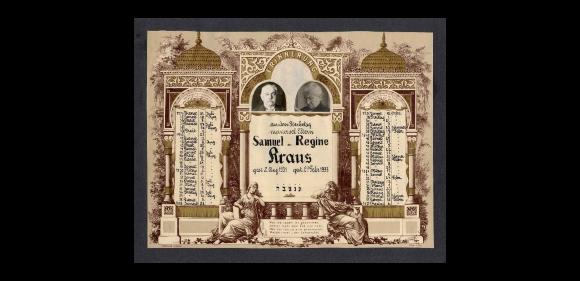
    Yahrzeit plaque of the husband and wife Samuel and Regina Kraus, who died in 1931 and 1933, with their photographs.

  • Yahrzeit plaque, after 1929

    Yahrzeit plaque of Mr. Gustav Hermann, who died in 1929.

    Within the arches is a depiction of Rachel’s Tomb and the tombs of the forefathers. The ornamentation includes traditional Jewish symbols: the tablets of the Ten Commandments (indicated by Roman numerals), the Star of David, and guardian lions. In addition to the name of the deceased, Gustav, the text also includes the name of the surviving son, Otto.

  • Yahrzeit plaque , after 1934

    Yahrzeit plaque of Mrs. Carla Schiff (neé Loewy), who died in 1934.

    This plaque is of interest for the addition of a stamped dedication – “Gewidmet aus Liebe und Verehrung von Deinem Sohne” (“Dedicated with love and respect from your son”) – and for the fact that the son’s name, Willi, is inscribed in gold-plated letters.

  • Yahrzeit plaque, after 1918

    Yahrzeit plaque for Julie Klein, who died in 1918.

    This framed plaque contains a winding mechanism, which always shows the current year.

  • Yahrzeit plaque, after 1867

    One of two preserved plaques for Mr. Leopold Beran, who died in 1867.

  • Yahrzeit plaque, after 1867

    One of two preserved plaques for Mr. Leopold Beran, who died in 1867.

  • Yahrzeit plaque, after 1934

    Yahrzeit plaque of Mrs. Henrietta Deutsch, who died in 1934.

    The architectural composition consists of a monumental tomb that is adorned with sculpted wreaths, garlands and urns with two mourning figures on the sides. The location of the deceased’s grave is stamped and written by hand below the plaque.

    Yahrzeit plaques were probably kept by the relatives of the deceased at their home, or they may have been handed over to officials at the synagogue or to the relevant synagogue association. Unfortunately, the provenance data on the Yahrzeit plaques at the Jewish Museum in Prague do not mention any specific places. Most of the plaques were acquired by the museum during the Second World War via the Prague Treuhandstelle (trustee office), which was set up by the Central Office for Jewish Emigration. Many of the plaques were framed, which suggests that they had been hung on the walls of people’s homes. Some of the details (such as the precise specification of the location of the grave), however, indicate that the plaques were also used as aids by persons other than close relatives.

  • Yahrzeit plaque, after 1922

    Yahrzeit plaque of Mr. Sigmund Gruenfeld, who died in 1922.

    The wife of the late 70-year-old had the dates of the Yahrzeit written for 50 years in advance, from which it may be inferred that the plaque was intended for a third party or for an institution.

  • Yahrzeit plaque, after 1927

    Yahrzeit plaque of Mrs. Gusti Hermann, who died in 1927.

    The deceased is referred to as a wife and mother. The wording on the Yahrzeit plaque is reminiscent of a funeral notice.

  • List of Yahrzeits, 1901

    List of Yahrzeits, Tábor.

    In addition to Yahrzeit plaques, the museum’s collection also includes lists of Yahrzeits belonging to groups of people, usually members of a particular community or contributors to certain charities. These plaques are primarily functional, which is why they are mostly unadorned. For inclusion on the list, which guaranteed Yahrzeit observance in the prescribed manner, it was customary to donate to charitable causes.

    Inscription: In memory of the souls of the sons of Israel mentioned here, for the High Holidays and (…) to recite Kaddish at Yahrzeit.

  • List of Yahrzeits, after 1900

    List of Yahrzeits, Sedlčany.

    Inscription: In eternal memory of the anniversary of the death [of the contributors] to the charitable fund (...) of the holy community of Sedlčany."

  • List of Yahrzeits, 1901 - 1933

    List of Yahrzeits, Karlín.

  • List of Yahrzeits, 1934

    List of Yahrzeits, Valašské Meziříčí.

    Signed with date: Josef Kohn, cantor of Valašské Meziříčí, 2 Novemeber 1934.

  • Yahrzeit plaque, after 1941

    Yahrzeit plaque of Mr. Heinrich Rubin, who died in 1941.

    Many of the preserved Yahrzeit plaques inadvertently bring to mind the unpredictable future. They point to a period that was survived by only a few people who could honour the memory of their deceased loved ones. Present-day Jewish communities support their members in keeping the Yahrzeit by, among other things, helping them calculate the death dates of their ancestors according to the Jewish calendar so they can light a candle on their memorial day for 24 hours (using traditional, electric, or virtual candles).

  • Yahrzeit plaque, after 1941

    Yahrzeit plaque of Mrs. Otilie Becková, who died in 1941.

All on-line exhibitions