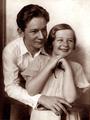
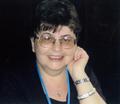
Zuzana Marešová with her parents and sisters, 1938
“My mother was Austrian, my father a Jew, so we were a mixed family. My father was a self-employed chemist who had his own workshop for making technical dental products, my mother was a housewife, and I had two older sisters. Looking from today's perspective, it was a happy childhood on the whole. We were kind of upper middle class, so were definitely not in need. My mother formally converted to the Jewish faith, but we were not Orthodox. I remember that we went to temple once a year for Yom Kippur. And I remember as a little girl that we weren't allowed to eat anything that day as it was a fast. I can remember how it was in the temple as if it were yesterday, with the men downstairs and the women upstairs behind a carved-out wall. Whenever anyone felt faint from hunger, my mother would take out a clove apple for them to smell. It was then permitted to eat matzo, which was Jewish bread filled with apple cream and apple purée, and we would chew on parsley. This was a ritual that has its roots in Jewish tradition. I think that we went to temple out of duty for our father's parents, but otherwise we didn't live in a religious way.”
Zuzana Marešová with her sisters next to an inscription that reads “Truth Prevails, TGM”
“A third of Prague was Jewish before the war. There was a large Jewish community here. I remember that we went to Staré Splavy, a beautiful spot on Lake Mácha, which I would say was very Jewish. It was more of a village than a town. We went there on holiday and it was where we all used to meet up. I remember being there with some other children just before the war, when signs of antisemitism were emerging. We made a huge heart out of sand and cones, in which we wrote the initials TGM [Tomáš Garrigue Masaryk, the first President of Czechoslovakia], but a gang of kids came over and kicked right through it. I don't know if they were Germans but it had a racist subtext back then.”
Zuzana Marešová in the first grade, 1938
Zuzana was only able to attend the first grade of her elementary school, as she was included in the list of children to be sent on Winton's trains in July 1939. “To this day, I don't know how my mother arranged it. All my fellow pupils that were in England had the same experience, in that their parents and relatives – if they had survived – never wanted to speak about this time. When we were adults and asked about it, the topic of conversation was always diverted.”
Maxmilián Spitzer in England
At the time Germany occupied Czechoslovakia, Maxmilián Spitzer was in London, making plans to open a branch of his firm there. “His products were so well-known that he took part in a world exhibition. “Gyps S” [Plaster S] was a famous brand. When we returned after the war and I went to the dentist, I could see that he still had supplies from my father. My father was very capable. He only had one assistant who helped him out and delivered goods to dentists on a bike with a large crate.” After the German occupation, Pavla Spitzerová remained in Prague alone with her daughters. She then arranged for them to leave for England and later went there herself.
Zuzana Marešová: registration number with the Czech Refugee Trust Fund in Great Britain, 1942
“I didn't show such an interest when I was young, but when there came a time when I needed answers to certain questions and it meant a lot to me, then unfortunately my parents were no longer alive. My father was in England and my mother stayed here. She had arranged for all three of us girls to get on that one train. Of course I spoke about it with Mr. Winton, but he can't remember it. There were 669 of us and he had received more than two thousand requests. To this day I wonder about the criteria that was used, but it isn't on my mind too much. There were eight trains in total, I think. The train that I went on was the last but one. Another one came after that, and the last one was to have set off in September but the Germans didn't let it go. What I remember about that journey was that my mother had given me a beautiful little book and told me that I was going to a country where these flowers grow. I can remember that to this day. And I can remember being on the train and seeing people weeping terribly outside the window, which we didn't really understand because we thought of it more as an adventure, as if we were going on a trip somewhere. These days, when I recall how it must have been for the parents who said their farewells at the station without knowing if it was the last time they would see their children. It must have been something terrible to send their children away like that. Wherever we go and wherever we are welcomed and interviewed, we are regarded as heroes. But what happened to us children was without any effort being made on our part, so I regard the parents as the heroes. This is why I cannot imagine what it was like for them. I simply cannot imagine.”
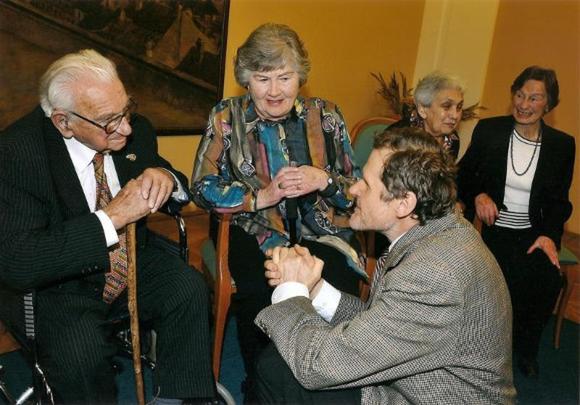
Zuzana Marešová with Nicholas Winton
“We had a pasteboard sign with a number, and some wrote their names on the other side. Opposite me sat a little girl whose name was just before mine on the list. She was about a year younger and had the same name as me. Such an odd coincidence. Before my departure I got lost in what were unfortunately strange circumstances. I don't like to talk about this as it evokes the atmosphere in which the children were selected for that train. I asked Mr. Winton if this was possible and he said that he could remember something of the kind, which is why the train was delayed for about two hours. But he also didn't want to talk about it. And, of course, I also got lost in London immediately after arriving there. There was a frightful muddle there as the children arrived, their adoptive parents were waiting for them and in the confusion I got lost somewhere, but in the end I can remember that a gentleman looked at my number and we were announced over the loud hailer. My father was there, as he had come for us, but there was also this gentleman there who was to adopt us. We weren't allowed to leave Czechoslovakia on our own, so our only opportunity to get to England was as part of Mr. Winton's operation and on condition that each child was to stay with a family.”
Zuzana Marešová: UK Identity card, 1945
“My father was not allowed to get a proper job during his first year in England. Refugees were only allowed to do inferior jobs and they didn't even have proper flats. They lived in lodgings as the government did not recognize them as coming from friendly countries, because Czechoslovakia was occupied by the Germans. It took a year before this matter was somehow cleared up and we were then given emigrant status as refugees in danger. No-one was able to look after us that year. My mother arrived later on her own. It was easier for her as she was not Jewish. So my parents were together and we were not allowed to be with them. My elder sister went to a boarding school and my middle sister was sent to another family, as was I. I stayed the longest with that family – about two and a half years. I only saw my parents once during that time. My mother came to see us, but I was no longer able to communicate with her as I couldn't speak Czech or German any more. Just English. This is why, towards the end of the war, I was sent to a Czechoslovak secondary school, which had been founded by our caretaker government. I went there and learned to speak Czech, but unfortunately not well enough to be graded in certain subjects there until the time we returned. I still have problems with the Czech language to this day. Sometimes I simply feel that English is closer to me than Czech.”
Zuzana Marešová with the Thomas family
“The Thomases, with whom I lived, were an aristocratic family. The grandfather was a member of parliament. They lived in a stone mansion in Cornwall. Everyone there wanted to do their bit for their country and they thought that they would be doing something against the war if they adopted a poor foreign child. But I was not satisfied there. I wasn't badly off materially, as I had fine clothes, didn't suffer from hunger and went to an English school. But they were 'cold fish'. I was never stroked for the whole time I was there… And this was emotionally very bad from the outset when they took a seven-year-old child. They had a main house and a smaller house that was connected through a glazed corridor across the garden, and that is where the children lived with their nanny. I can remember one time, when I didn't speak a word of English, there was a terrible storm and I woke up and was really scared, as it was all so empty where I was sleeping, so I made my way through the corridor and came to my parents who were in their bedroom. Their children were with them in bed and I tried to let them know that I was scared by waving my arms about and saying “boom, boom”. I can remember as if it were yesterday, and the lady got up, took me by my hand and led me back to the small house where I stayed all alone. I'll never forget that because of the feeling of horror I had as a child. Also, I was never allowed to eat at the table with them when it was my birthday or Christmas or a holiday. I ate in the kitchen with the servants. In every interview that I give, I say that their first priority was themselves, then their horses, then the servants, then the dogs, and then the foreigners. That was their view of people.”
Zuzana Marešová with her father and sisters
“My middle sister was well off, as her family was kind on the whole, but her parents later sent her to an English boarding school. My elder sister went to a boarding school before she was eighteen and when she was eighteen she joined the U.S. army. After the war she went to Germany with the Americans as the occupying force. My father had gone there in advance when the war ended. I then went home by train with my mother and my middle sister.”
My Dear Robert
One of the key roles of the Holocaust Documentation Department is the preservation and care of family archives.Most often,...
V synagoze na půdě
Co je to geniza?
Geniza je zvyk odkládání předmětů, které již neplní svou roli v náboženském životě...
Souvenirs from the Sea
The collection of the Jewish Museum in Prague also contains a small and rather curious group of objects in the form of sea...
Left-handed Torah pointers
The Torah, which contains the Five Books of Moses, is the central concept of the Jewish religion. In its physical form, it is a...
Dragons and Cornucopias – Tomáš...
The Torah is a central feature of the Jewish religion. In its physical form, it is a parchment scroll containing the Five Books...
The Yahrzeit Is Not a Season
In a small-town shul (synagogue) there’s a dispute about who should daven shacharit (say morning prayers) far’n omed (at...
Going into Battle with Prayer. The...
During World War II Jews from Czechoslovakia significantly participated in the fight against Nazi Germany. They were entering the..."I no longer have to be afraid of...
"I'm glad I've had this opportunity to recall my parents in this way. By remembering them, I think I've prolonged their lives,...
The unKnown
The Photo Archive of the Jewish Museum in Prague contains hundreds of photographs about which very little was known just a few...Terezín collection on-line!
During WWII, the ghetto Terezín (Theresienstadt) was one of the major sites of suffering and death for the Jews of the Bohemian...“You are now my only hope.” The...
The collection of letters from their family to brothers Oskar, Moses (Max) and Norbert (Bubik, Bertie) who, after the occupation...